How much does a silver half dollar weigh? What should the edge look like? Can a coin pass a weight test and still be wrong? Can a coin value app help with checking authenticity? These are the right opening questions. Authentication usually starts with simple checks, not advanced tools. A collector needs a clear order: specs first, then size, edge, surface, and comparison.
Why the First Check Starts With Basic Data
A suspicious coin often fails in ordinary places. The weight may be off. The diameter may not match. The edge may look soft, filed, or strange in color. Many problems appear before magnification or expert review.
This is why authentication begins with published standards. Every coin type has a normal weight, diameter, thickness, edge style, and metal composition. Without that baseline, a collector only guesses.
A silver half dollar is a good example. Many people know that older half dollars can be silver. Fewer know that not all silver half dollars have the same weight. That matters. A 90% silver half dollar does not weigh the same as a 40% silver Kennedy half dollar. A clad Kennedy half dollar is different again.
Start With The Published Specs
The first useful step is simple: confirm the type, then confirm the basic numbers. Do not start with the portrait. Do not start with the date alone. Start with the coin’s standard profile.
Typical Half Dollar Standards
| Coin Type | Composition | Standard Weight | Diameter | Edge |
| 90% Silver Half Dollar | 90% Silver, 10% Copper | 12.50 G | 30.6 Mm | Reeded |
| 40% Silver Kennedy Half Dollar | 40% Silver outer layer, 79% Copper / 21% Silver Core | 11.50 G | 30.6 Mm | Reeded |
| Clad Kennedy Half Dollar | Copper-nickel Clad over Copper core | 11.34 G | 30.6 Mm | Reeded |
This table does not solve every case. It does give a starting line. A coin that misses these numbers by too much needs more checking. A coin that matches them still needs more checking, too. That is the key point.
Weight Comes First, But Weight Does Not Finish the Job
Weight is the fastest first filter. It helps with silver coins, wrong planchets, cast copies, and plated pieces. A cheap digital scale can already remove many bad coins from consideration.
Still, weight is not proof by itself. A counterfeit can come close. A genuine coin can lose a little mass through wear, rim damage, filing, or past cleaning. Dirt and residue can distort a reading, too. The reading matters, but the context matters more.
What Weight Can Tell You
- The coin is far outside the expected range
- The metal may be wrong
- The piece may be cast or plated
- The coin needs more checks
What Weight Cannot Prove
- The coin is definitely genuine
- The strike is correct
- The surface has not been altered
- The coin has no added or removed material
This is where many beginners go wrong. They weigh the coin, see a close number, and stop. That creates false confidence. Real screening uses more than one test.
Size Often Confirms or Exposes the Problem
After weight, check diameter and thickness. A coin can come close in weight and still be wrong in size. A fake made from low-value metal may be thicker to reach the correct mass. Another copy may be too thin because the maker tried to imitate the surface look, not the full shape.
A caliper helps here. It does not need to be expensive. The result should match the published standard, or at least fall close enough to make sense for the coin’s condition.
Why Size Matters
- A coin can be close in weight but wrong in diameter
- A thick coin may hide the wrong metal
- A thin coin may point to wear or alteration
- Weight and size should make sense together
A coin that fails both scale and caliper tests is easy to doubt. A coin that passes both still needs more attention, but the chance of a simple fake goes down.
The Edge Often Gives the Fastest Visual Answer
The edge is one of the most useful places to inspect. Many people skip it. That is a mistake.
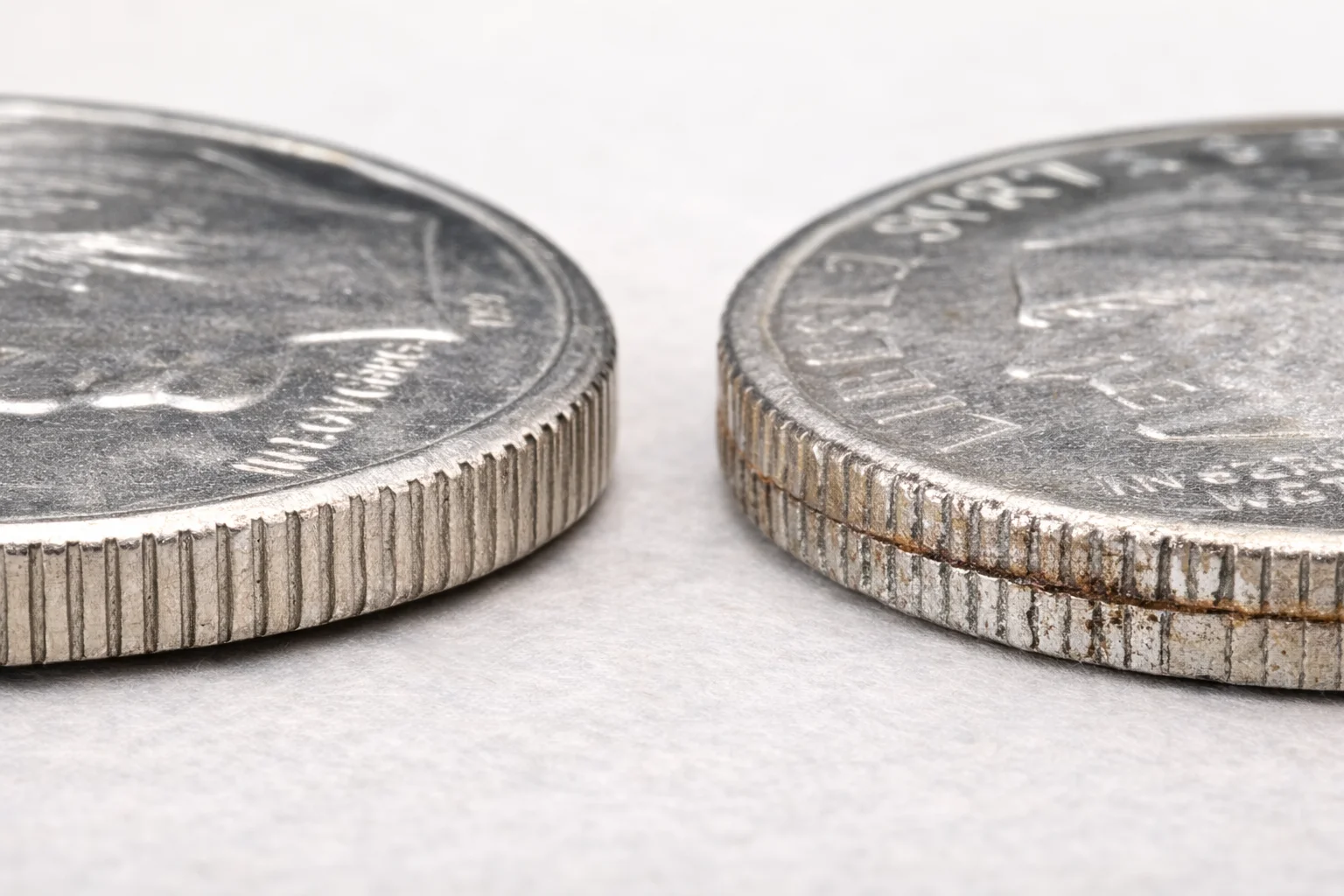
The edge can reveal plating seams, color changes, filing, blunt reeds, and poor finishing. On clad pieces, the copper core often shows clearly at the edge. On silver coins, the look should match the metal and age of the piece. If the edge feels wrong, the rest of the coin deserves harder scrutiny.
Edge Red Flags
- A visible seam
- Uneven reeding
- Soft or blurry reeds
- Strange color bands
- Filing marks
- A mismatch between the edge and the surface
This test is quick. It is also practical in hand. You do not need a microscope. A loupe and good light are enough for a first decision.
Surface and Strike Tell a Different Story
A genuine coin struck by dies usually has a certain look. The design transitions are sharper. Letters tend to be cleaner. Relief flows more naturally into the fields. Luster, when present, moves in a more convincing way.
A cast fake often looks different. The texture may seem grainy or porous. The letters may look swollen or rounded. Fine details can appear soft even when the coin is not worn. Protected areas sometimes look weak in a way that does not match normal circulation.
Genuine-Looking Clues vs Fake-Looking Clues
| Area | Genuine-Looking Clues | Fake-Looking Clues |
| Fields | Smooth, natural texture | Grainy, uneven texture |
| Lettering | Cleaner edges | Rounded or mushy edges |
| Relief | Sharper transitions | Soft or dull transitions |
| Luster | Natural flow | Flat or artificial shine |
| Fine Detail | Strong in protected areas | Weak even in protected areas |
This part takes practice. It improves with direct comparison. One suspicious coin by itself can fool the eye. Two similar coins side by side are much easier to judge.
Simple Home Tests Help, But They Have Limits
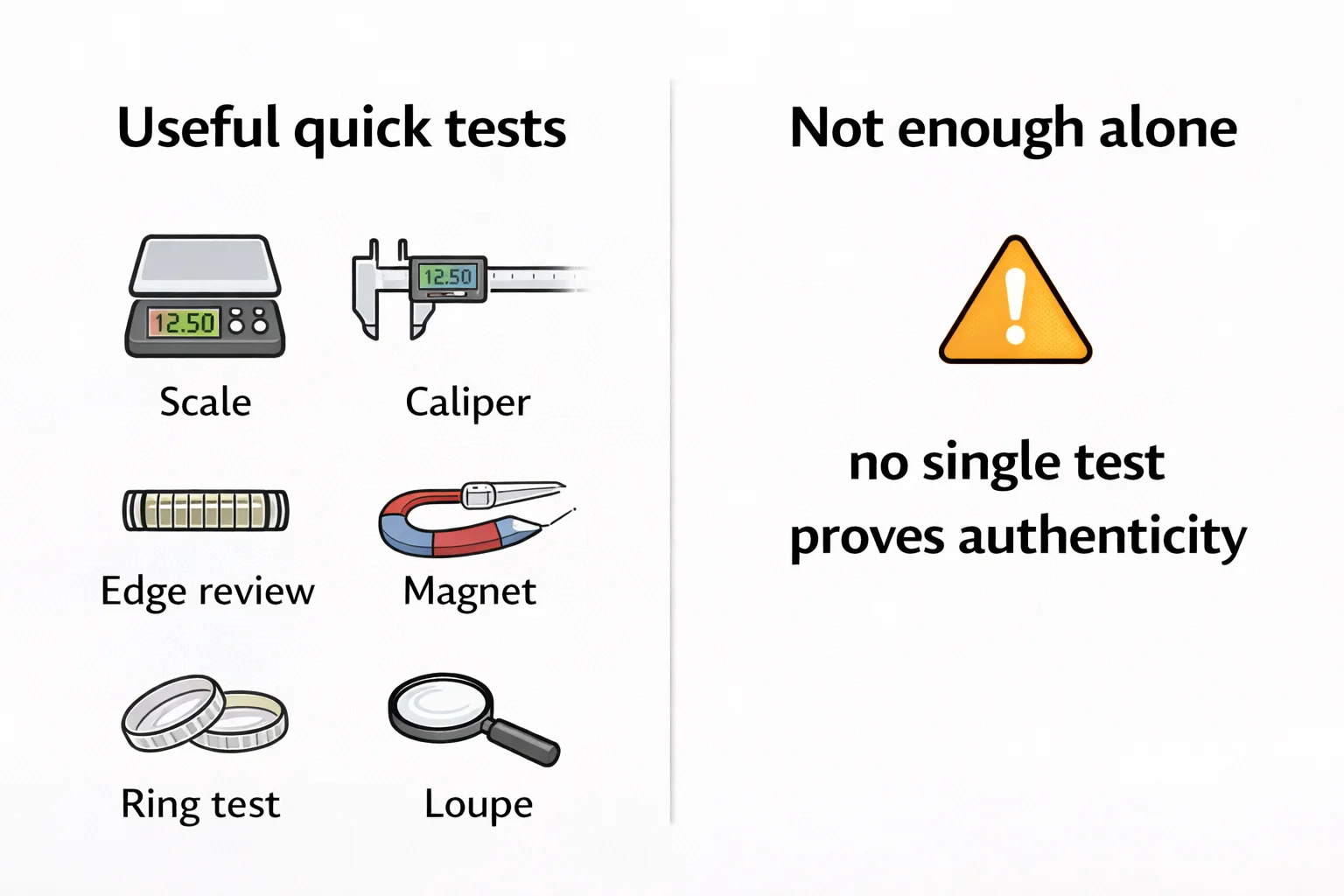
Collectors often use a small group of home checks. These are useful. None of them should stand alone.
Useful Quick Tests
- Digital scale
- Caliper check
- Edge review
- Magnet test
- Ring test
- Loupe inspection
A magnet test can remove some obvious bad metal mixes. It does not authenticate silver by itself. A ring test can help with experience, but sound changes with damage, thickness, handling, and setting. A loupe is excellent for edges, fields, and lettering, but it only helps if the collector knows what to compare.
These tests are strongest when used together. One result may be unclear. Four consistent results give a better picture.
Compare the Coin With a Known Genuine Example
Direct comparison is one of the best habits in coin work. Put the suspicious coin beside a genuine example of the same type, if possible. Check weight, diameter, edge, color, portrait style, lettering, and general shape.
A coin identifier can help at the first sorting stage. It is useful for matching the type, date, and design before deeper checking. It is not enough for authentication by itself. A correct image match does not confirm the coin in hand.
Coin ID Scanner is useful here because its AI assistant can answer basic coin questions, its database covers more than 187,000 coins, and Smart Filters help narrow possible matches. That saves time at the reference stage. The final call still belongs to the coin in hand.
Comparison often solves what theory cannot. A suspicious piece may look acceptable alone and wrong next to a real one. That is common with cast copies and altered coins.
Genuine Coins Can Still Trigger Suspicion
Not every odd coin is fake. Some genuine pieces fail simple checks for honest reasons. Heavy wear lowers weight. Old cleaning changes the surface. Rim filing can disturb the size and edge appearance. Dirt and residue can affect a reading. A damaged coin may sound wrong in a ring test.
Why a Genuine Coin May Look Wrong
- Heavy circulation wear
- Old cleaning
- Rim damage
- Surface residue
- Bad lighting
- Measurement error
This is why authentication should stay calm and methodical. One unusual clue is not the end of the case. It is a signal to check the next point.
A Practical Order That Works
Collectors often need a routine more than a theory. A clear order prevents missed details and rushed conclusions.
Basic Authentication Order
- Confirm the coin type
- Check the published specs
- Weigh the coin
- Measure diameter and thickness
- Inspect the edge
- Review the surface and strike
- Use magnet and sound only as support tests
- Compare with a known genuine example
- Pause if one detail still feels wrong
This order is simple enough for beginners and useful enough for experienced buyers. It also works in coin shops, shows, estate groups, and mixed silver lots.
Final Thoughts
Coin authentication does not begin with a rare tool. It begins with the right sequence. Weight is important. Size matters too. The edge often gives a fast clue. Surface and strike help separate a struck coin from a poor copy. Comparison turns doubt into a clearer decision.